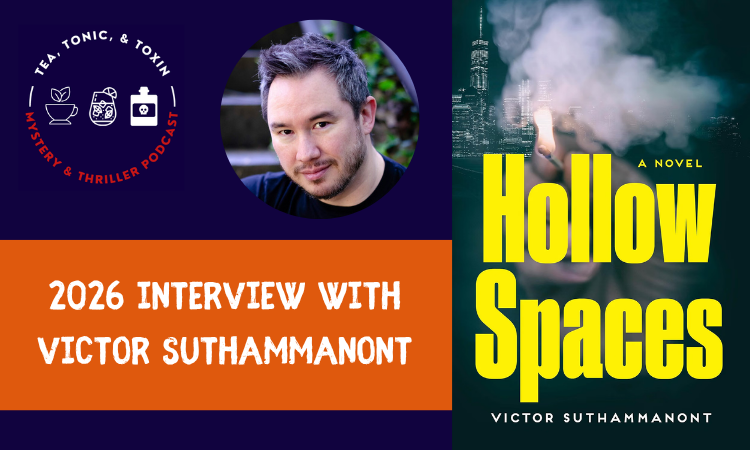
- Let’s start with John Lo. Where did he come from? Was the novel initially John’s story, Brennan and Hunter’s story, or a murder mystery. Or did those pieces emerge together?
- You made an interesting structural choice: the “Now” sections belong primarily to Brennan and Hunter, while the “Then” sections allow us to better understand John’s perspective. Why was it important for readers to know John from the inside while his children are trying to reconstruct him from the outside? How does that difference between what we know and what they know shape the mystery?
- How did you write the dual timeline? Did you move back and forth between Now and Then as we experience them, or did you write substantial portions of John’s story and Brennan and Hunter’s story separately and then weave them together?
- John is acquitted, but the verdict doesn’t restore his life. His law firm wants him gone, his neighbors suspect him, and even his son believes he may be a murderer. Were you interested in the difference between legal innocence and social innocence and in whether someone can ever truly be acquitted in the court of public opinion?
- Harris warns Brennan and Hunter that investigating their father may destroy their memories of him without giving them certainty: “You’ll never know for sure what happened.” This seems like one of the central dilemmas of the novel. Does knowing more about the people we love necessarily mean understanding them better? And is certainty actually what Brennan and Hunter need in order to make peace with their father?
- Brennan and Hunter initially seem to have chosen opposite responses to their father. Brennan defends him; Hunter judges him. Yet both have inherited quite a lot from John. How consciously did you build those parallels between John and his children? Were there similarities you discovered only as you wrote them?
- Hunter says he doesn’t want to fall into John’s traps: marriage, children, an office job and “everyone else’s fucked-up expectations.” Yet his determination not to become his father seems to be another way his father controls his life. Do you see Hunter as someone running away from John or becoming more like him by running away?
- Brennan’s parallels with John are striking: she’s an ambitious attorney, she’s unfaithful in her marriage, she’s sleeping with her married boss, and she’s advancing professionally after defending a client in a morally questionable case. Does understanding John eventually force Brennan to understand something uncomfortable about herself? And does that change what accountability—or forgiveness—means to her?
- Victor Suthammanont, something fascinating about John is that the novel doesn’t make his flaws disappear just because terrible things happen to him. He cheats on Jane, hurts his family, and makes bad choices. He’s also subjected to racism and injustice. HHow important was it to resist making him either a victim we champion or a flawed man we condemn? Were you interested in asking readers to separate what John deserves accountability for from what happens to him unjustly?
- Early in the novel, John thinks that white people have difficulty discerning what he’s thinking. Elsewhere, he knows exactly what being the only Asian American partner with a middling book of business means for his position at the firm. How interested were you in the gap between overt racism and the quieter calculations people from underrepresented groups learn to make inside elite institutions? Does constantly having to make those calculations contribute to John’s isolation?
- Cathy says she didn’t expect Jessica to be attracted to a Chinese man because “Chinese guys were not our average.” She apparently doesn’t realize that she’s talking to two people who are half-Asian. Can you talk about the racism that appears in moments like this—not necessarily as overt hostility, but in casual assumptions made by people who may not even recognize what they’re saying?
- John doesn’t use his Chinese name, gives his children white names, and doesn’t teach them the little Teochew [tee-oh-chow] he remembers. Food becomes one of the ways the family reconnects with heritage and with one another. What interested you about assimilation not simply as something imposed on John, but as a series of choices he makes and then passes down to his children? And why did food become the place where some of what was lost could be recovered?
- The reinvestigation reveals information [unidentified handprint, evidence about Jessica and Mark’s violent relationship, Cathy’s married boyfriend] that might have changed John’s defense but was never pursued or disclosed. The novel seems interested in institutional bias not necessarily as one grand conspiracy, but as an accumulation of smaller decisions about whose story is believed, which leads are worth pursuing, and who already looks guilty. Was that how you thought about the investigation?
- There’s a great line on the first page: “[John] thought that he would be used to waiting, being a spectator floating in his own shoes, watching a doppelganger walk through his life.” It captures something larger than being accused of murder: the feeling that your life is happening to someone else. Did that idea emerge specifically from John’s experience, or is alienation—the feeling of being an outsider even within your own life—one of the larger themes you wanted to explore?
Loneliness runs through nearly every strand of the novel: John’s isolation at the firm and within his marriage, Jane’s isolation after his affair and trial, and the very different kinds of distance Brennan and Hunter create in their adult lives. Did you see loneliness as something this family almost inherits from one another?
Jane is obviously shaped by what John does, but Brennan and Hunter are also shaped by how Jane responds to it. When you were building this family, how interested were you in the idea that children inherit not only their parents’ traits and mistakes, but also their parents’ responses to each other’s mistakes?
Brennan and Hunter spend much of the novel debating two ideas that aren’t necessarily the same thing: accountability and forgiveness. Does forgiveness require knowing exactly what someone did? And can you hold someone accountable while still loving—or even forgiving—them?
John and Jessica’s affair sets almost everything in motion, but Jessica herself risks becoming known primarily as “the woman John was sleeping with” or “the murder victim.” What drew these two people to each other, and how important was it to give Jessica a life and set of pressures that existed independently of John?
You’re an attorney writing a novel where lawyers, law firms, prosecutors and the justice system play important roles. What did being a lawyer allow you to see or write differently, and were there things you had to deliberately unlearn as a lawyer to write fiction?
How do you balance a demanding legal career with creative writing? Is writing fiction an escape from the kind of thinking you do as an attorney, or does one feed the other?
Victor Suthammanont, Hollow Spaces is your debut novel. What about becoming a published novelist has happened the way you imagined it would, and what has been completely different?
After living with John, Jane, Brennan, and Hunter for so long, what did writing Hollow Spaces teach you about the kind of writer you want to be? What are you writing next?
Jane could easily be treated simply as “the wronged wife,” but she has her own complicated relationship with John. Thirty years later, she’s the person who sets Brennan and Hunter on this path. We learn, for example, that John never actually denied killing Jessica. Why does Jane reopen these questions about John when she knows she may not live to see where the investigation leads? Is she looking for an answer herself, or is this something she needs Brennan and Hunter to do for themselves?
What are the “hollow spaces” of the title? (The things the family doesn’t know, the spaces created by assimilation and loss, the distance between family members, or something else?)
Near the end of her life, Jane watches episode after episode of Law & Order. We recently spoke with Rachel Corbett about the comfort of police procedurals. The crime is contained, investigated, and resolved. Was there something deliberate about giving her ordered justice while her own family’s defining crime has remained unresolved for 30 years?