

Crime Novel Red Harvest by Dashiell Hammett
Dashiell Hammett’s crime novel Red Harvest is more than just a gripping detective story. It’s also a political statement, inspired
Sarah Weinman is the author of Without Consent, winner of the 2026 ASJA Book Award in History/Biography; Scoundrel, named a Best Book of 2022 by Time, Esquire, CBC, and NPR; and The Real Lolita, named a Best Book of 2018 by NPR, BuzzFeed, The National Post, Literary Hub, the San Francisco Chronicle, and Vulture.

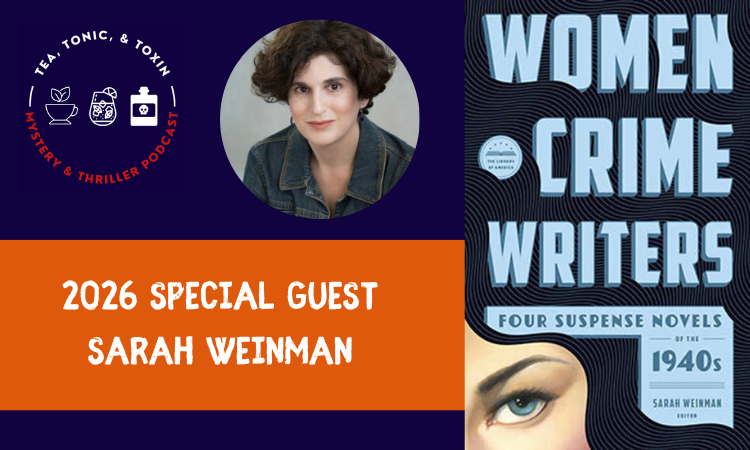
Sarah Weinman joins Tea, Tonic & Toxin to discuss Women Crime Writers: Eight Suspense Novels of the 1940s & 50s (Library of America). She is widely recognized as a leading authority on crime fiction.
Sarah is the author of three books: Without Consent, winner of the 2026 ASJA Book Award in History/Biography; Scoundrel, named a Best Book of 2022 by Time, Esquire, CBC, and NPR; and The Real Lolita, named a Best Book of 2018 by NPR, BuzzFeed, The National Post, Literary Hub, the San Francisco Chronicle, and Vulture, and winner of the Crime Writers of Canada Award in Nonfiction.
She also edited Evidence of Things Seen: True Crime in an Era of Reckoning; Unspeakable Acts: True Tales of Crime, Murder, Deceit & Obsession, winner of the Anthony Award for Best Nonfiction/Critical Work; Women Crime Writers: Eight Suspense Novels of the 1940s & 50s (Library of America); and Troubled Daughters, Twisted Wives (Penguin).
Sarah Weinman writes the monthly Crime & Mystery column for the New York Times Book Review. A 2020 National Magazine Award finalist for Reporting and the recipient of fellowships from MacDowell, Art Omi, and the Virginia Center for the Creative Arts, her work has also appeared most recently in Rolling Stone, The Atlantic, Esquire, New York, and Vanity Fair, while her fiction has been published in Ellery Queen’s Mystery Magazine, Alfred Hitchcock’s Mystery Magazine, and numerous anthologies.
She also writes (albeit more sporadically) the “Crime Lady” newsletter, covering crime fiction, true crime, and all points in between. She lives in New York City.
Laura, Vera Caspary | The Horizontal Man, Helen Eustis | In a Lonely Place, Dorothy B. Hughes | The Blank Wall, Elisabeth Sanxay Holding
This collection, the first of a two-volume omnibus, presents four classics of the 1940s overdue for fresh attention. Anticipating the “domestic suspense” novels of recent years, these four gripping tales explore the terrors of the mind and of family life, of split personality and conflicted sexual identity.
Women writers have always had a central place in American crime writing, although one wouldn’t know it for all the attention focused on the men of the hardboiled school. This collection, the first of a two-volume omnibus, presents four classics of the 1940s overdue for fresh attention. Anticipating the “domestic suspense” novels of recent years, these four gripping tales explore the terrors of the mind and of family life, of split personality and conflicted sexual identity.
Vera Caspary’s Laura (1943) begins with the investigation into a young woman’s murder and blossoms into a complex study, told from multiple viewpoints, of the pressures confronted by a career woman seeking to lead an independent life. Source of the celebrated film by Otto Preminger, Caspary’s novel has depths and surprises of its own. As much a novel of manners as of mystery, it remains a superb evocation of a vanished Manhattan.
Helen Eustis’s The Horizontal Man (1946) won an Edgar Award for best first novel and continues to fascinate as a singular mixture of detection, satire, and psychological portraiture. A poet on the faculty of an Ivy League school (modeled on Eustis’s alma mater, Smith College) is found murdered, setting off ripple effects of anxiety, suspicion, and panic in the hothouse atmosphere of an English department rife with talk of Freud and Kafka.
With In a Lonely Place (1947), Dorothy B. Hughes created one of the first full-scale literary portraits of a serial murderer. The streets of Los Angeles become a setting for random killings, and Hughes ventures, with unblinking exactness, into the mind of the killer. In the process she conjures up a potent mood of postwar dread and lingering trauma.
Raymond Chandler called Elisabeth Sanxay Holding “the top suspense writer of them all.” In The Blank Wall (1947) she constructs a ferociously taut drama around the plight of a wartime housewife forced beyond the limits of her sheltered domestic world in order to protect her family. The barely perceptible constraints of an ordinary suburban life become a course of obstacles that she must dodge with the determination of a spy or criminal.
Psychologically subtle, socially observant, and breathlessly suspenseful, these four spellbinding novels recapture a crucial strain of American crime writing.
Visit the companion website for more on these works and writers, including jacket art and photographs, chronologies of crime novels by women and movie adaptations, and new appreciations by Megan Abbott, Charles Finch, Laura Lippman, Sara Paretsky, Lisa Scottoline, Karin Slaughter, Duane Swierczynski, and Lisa Unger.
This Library of America series edition is printed on acid-free paper and features Smyth-sewn binding, a full cloth cover, and a ribbon marker.
Let’s start with Women Crime Writers. How did this project come about, and how did you arrive at these eight books, and specifically these four novels for the 1940s?
When you assembled the collection in 2015, Laura was famous, at least in part because of the film, while books like The Horizontal Man and The Blank Wall were far less familiar to contemporary readers. Were you consciously balancing rediscovery with books that could provide an entry point into this larger tradition?
Sarah Weinman, were there 1940s novels or writers you desperately wanted to include but couldn’t? And if you were putting together the collection for the first time today, would the four remain the same?
You begin your introduction by challenging the traditional story of American crime fiction as essentially a male lineage (Poe, Hammett, Chandler, the pulps, etc.). Why did the male version of that history become so dominant when women had been writing crime fiction almost from the genre’s beginning?
One of the things I found fascinating in your publishing history is that women weren’t necessarily marginal in the 1940s. They published in hardcover at major houses and worked with enormously influential editors. Were these writers forgotten later rather than overlooked in their own time?
You identify this midcentury tradition as “domestic suspense.” What does that term mean to you, and what connects four books as outwardly different as Laura, The Horizontal Man, In a Lonely Place, and The Blank Wall?
Let’s start with Laura. Of these four books, it’s probably the one most people think they know (even if what they really know is Otto Preminger’s film). What do we miss about Vera Caspary’s novel when we primarily remember Laura as a classic Hollywood movie?
You describe Laura as both a mystery and a novel of manners about the pressures facing a career woman trying to live independently. How radical was Laura Hunt as a female character in 1943?
The men in Laura are constantly constructing versions of Laura. Waldo especially, but Mark as well. Yet Vera Caspary eventually gives Laura her own voice. Is the novel partly about a woman reclaiming herself from the stories men tell about her?
Sarah Weinman, Vera Caspary’s use of multiple narrators also means that the reader has to ask not simply “What happened?” but “Whose version of this woman am I hearing?” How important was that narrative experimentation to the kind of psychological crime fiction women were beginning to write?
Do you think the success of the film ironically helped preserve Laura while also obscuring Vera Caspary’s achievement as a novelist?
The Horizontal Man may be the strangest of these four books. It combines a campus whodunit, satire, psychoanalysis, shifting viewpoints, sexual anxiety, and some genuinely dark psychological material. What made you decide that Helen Eustis belonged in this collection?
Helen Eustis won the Edgar for Best First Novel, and yet this was her only crime novel. Why didn’t The Horizontal Man lead to a lasting place for her in the mystery canon?
I’d love your thoughts on Freda Cramm. Charles Finch has argued that the novel repeatedly raises the possibility that male characters mistake female independence, anger, or strength for madness. How do you read Freda, and how much is this novel about who gets to define what constitutes “normal” female behavior?
Sarah Weinman, one of the most fascinating things about the book is how psychologically unwell almost everyone at Hollymount seems to be. The book was published in 1946, when psychoanalysis was entering popular culture in a major way. How much should we read its treatment of psychology historically, and how much of it still feels perceptive today?
I want to ask about fair play without giving away the solution. The opening puts us ostensibly inside Kevin Boyle’s perspective but carefully controls what we’re allowed to know. Do you think Helen Eustis plays fair with the reader, or is she deliberately doing something different from the classical fair-play mystery?
The book’s shifting perspectives reminded us somewhat of Laura. Do you see a connection between these women experimenting with point of view and their larger interest in identity, particularly the difference between who someone is and who other people believe that person to be?
Then we get to In a Lonely Place, which feels astonishingly modern. Why do you think Dorothy B. Hughes’s novel has aged so well?
Hughes makes the extraordinary decision to put us inside Dix Steele’s consciousness. What does she gain by placing the reader so close to him while refusing to turn psychological understanding into sympathy or excuse?
How revolutionary is Sylvia Nicolai? You specifically contrast her with the largely ornamental women we encounter in some male hardboiled fiction. What does Sylvia understand that Dix doesn’t understand about her?
There’s an interesting reversal here. In traditional hardboiled fiction, the male detective often looks at women and decides whether they’re trustworthy or dangerous. In In a Lonely Place, aren’t the women effectively studying the man?
The Los Angeles of this novel is very different from Chandler’s Los Angeles even though they’re writing about roughly the same place and period. What does Hughes see when she looks at postwar Los Angeles that Chandler doesn’t see (or isn’t interested in seeing)?
Sarah Weinman, how important is World War II to understanding Dix? Is the novel specifically about a postwar male crisis, or would you resist explaining him too neatly through wartime trauma?
For readers who know the Humphrey Bogart film, how fundamentally different is the novel’s conception of Dix Steele? And is this another case where a celebrated adaptation has altered our cultural memory of the book beneath it?
Of these four books, The Blank Wall may be the one whose premise sounds least extraordinary: a wartime mother trying to keep her household functioning. And then Holding turns ordinary domestic responsibility into something resembling an espionage thriller. Why is this book so effective?
Lucia Holley is constantly doing things for other people (children, father, absent husband, household). Does Elisabeth Sanxay Holding turn the traditionally invisible labor of motherhood into the very skill set that makes Lucia capable of navigating a criminal crisis?
Sarah Weinman, is there something almost subversive about discovering that this seemingly ordinary suburban mother is capable of extraordinary things, not because she transforms into someone else, but because those capabilities were there all along?
The wartime setting means Lucia’s husband is physically absent while still structuring the family’s life. How important is that absence to the novel’s exploration of women’s independence?
The relationship between Lucia and Martin Donnelly is remarkably complicated. Without reducing it to a romance, what do you think Holding is doing with the emotional connection between these two people who should, according to the mechanics of the crime plot, simply be adversaries?
The book has been adapted twice, first as The Reckless Moment and later as The Deep End. What is it about The Blank Wall that allows the basic story to survive transplantation into very different eras?
Having read these four novels consecutively, what struck me is that they’re not simply four good mysteries written by women. They seem to be having a conversation with one another about women, identity, fear, and power. What do you see when you put these four books beside one another that isn’t as obvious when you read them separately?
In Laura, men construct an identity for Laura. In The Horizontal Man, characters constantly interpret one another psychologically. In In a Lonely Place, Dix constructs stories about himself and the women around him. In The Blank Wall, Lucia’s family has a very limited understanding of what she’s actually capable of. Is the gap between how women are perceived and who they actually are one of the connecting threads in these novels?
None of these books gives us the conventional hardboiled male detective at the center. What happens to crime fiction when the detective stops being the organizing principle of the story?
Fear also moves somewhere different. Instead of primarily being out on the “mean streets,” it enters the apartment, college, marriage, family, and mind. Was bringing danger into supposedly safe spaces one of these writers’ major innovations?
Sarah Weinman, there is an enormous amount of loneliness across all four books. Laura’s independence isolates her, Hollymount is populated by isolated people, loneliness is practically embedded in Hughes’s title, and Lucia is carrying an entire household largely alone. How central is loneliness to women’s midcentury suspense?
These novels are also filled with people who are being watched, interpreted, judged, or categorized. Do you think women writers were particularly attuned to surveillance in everyday social life because women themselves were subject to so much scrutiny about how they should behave?
Were these women consciously writing against the hardboiled tradition, or is that something we see more clearly in retrospect?
One of the most surprising things in your publishing history is what happens in the late 1940s and 1950s. Paperback originals explode, they’re marketed heavily toward men, male writers gain enormous print runs, while many women remain in hardcover with smaller library and book-club audiences. How much did the economics of publishing ultimately determine which writers we decided were important?
That raises an uncomfortable question about literary canon formation. Do we sometimes confuse “the books that remain available” with “the books that mattered most”?
Sarah Weinman, you point out that women dominate contemporary crime and suspense bestseller lists, yet many of their midcentury predecessors remain obscure. Do you think that historical gap has narrowed since Women Crime Writers appeared in 2015?
We’ve seen an extraordinary boom in domestic and psychological suspense over the last decade or two. How much of what is marketed as contemporary or innovative today would have been immediately recognizable to Elisabeth Sanxay Holding, Dorothy B. Hughes, Vera Caspary, Charlotte Armstrong, Margaret Millar, or Patricia Highsmith?
You’ve now spent years moving between crime fiction and true crime. Has studying fictional crime made you a better true-crime writer, or has reporting real crimes changed the way you read mystery fiction?
As the Crime & Mystery columnist for The New York Times Book Review, you see an enormous amount of contemporary crime fiction. Can you still trace the DNA of these midcentury women in the books arriving on your desk today?
You’ve done an enormous amount of work recovering overlooked stories and writers. What draws you to the things the accepted historical narrative has left out?
Between Troubled Daughters, Twisted Wives, Women Crime Writers, The Real Lolita, Scoundrel, Evidence of Things Seen, and Without Consent, there seems to be a recurring interest in who gets to control the story of a crime and whose perspective gets lost. Do you see that as a thread connecting your work, or is that something that’s clearer from the outside?
Has editing Women Crime Writers permanently changed the way you think about what belongs in the mystery canon?
Who is the woman crime writer from this period whom you still think readers aren’t reading enough? What overlooked book, writer, or corner of mystery history should we be paying more attention to?
Tell us what you think, and we may share your thoughts in our next episode and send you a fabulous sticker! (It really is a pretty awesome sticker.)
Tea, Tonic, and Toxin is a book club and podcast for people who love mysteries, thrillers, introspection, and good conversation. Each month, your hosts, Sarah Harrison and Carolyn Daughters, will discuss a game-changing mystery or thriller from the 19th and 20th centuries. Together, we’ll see firsthand how the genre evolved.
Along the way, we’ll entertain ideas, prospects, theories, doubts, and grudges, along with the occasional guest. And we hope to entertain you, dear friend. We want you to experience the joys of reading some of the best mysteries and thrillers ever written.

Teasers & Tidbits
Dashiell Hammett’s crime novel Red Harvest is more than just a gripping detective story. It’s also a political statement, inspired

When Dorothy L. Sayers wrote Whose Body? (her debut novel, published in 1923), she introduced a detective who would go

If you’re a fan of Agatha Christie’s murder mysteries, I’m sure you’re already familiar with Hercule Poirot, the eccentric Belgian

This detective novel introduces readers to a British mining engineer – Richard Hannay – who has just returned to London

Even though the name of this book is Trent’s Last Case, the novel is actually about the FIRST detective case

Long before he started writing his own detective stories, Gilbert Keith (G.K.) Chesterton was already a fan of the genre.
Get our most mysterious newsletter once a month. All mysterious goodness (PLUS giveaways). It’s delightful. We promise.
