Crime Novel Red Harvest by Dashiell Hammett
Dashiell Hammett’s crime novel Red Harvest is more than just a gripping detective story. It’s also a political statement, inspired
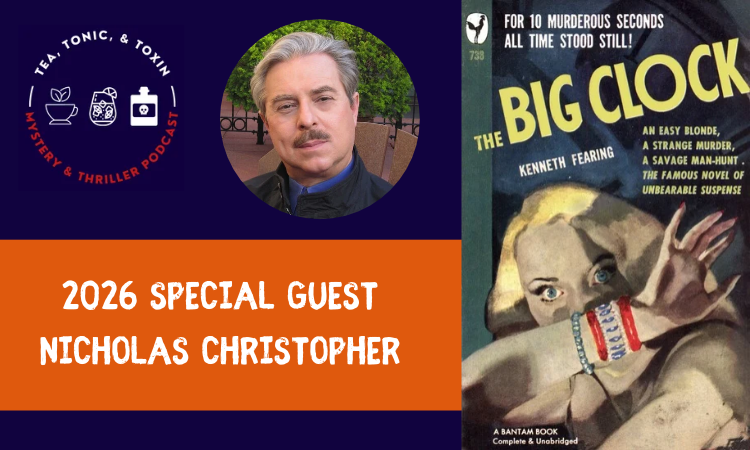
Nicholas Christopher is an award-winning novelist, poet, and film noir scholar whose books include A Trip to the Stars, Veronica, and Somewhere in the Night: Film Noir & the American City.
A professor at Columbia University, he joins Tea, Tonic & Toxin to discuss Kenneth Fearing’s The Big Clock, its film adaptations, and the fascinating world of film noir.
Scroll down to learn more about Nicholas Christopher, The Big Clock, and Somewhere in the Night.
Nicholas Christopher is an acclaimed American novelist, poet, and nonfiction writer whose work explores memory, mystery, identity, and the hidden dimensions of urban life.
He is the author of six novels, including The Soloist, Veronica, A Trip to the Stars, Franklin Flyer, The Bestiary, and Tiger Rag. He has also published nine collections of poetry, a novel for younger readers titled The True Adventures of Nicolò Zen, and the acclaimed nonfiction study Somewhere in the Night: Film Noir & the American City.
Christopher’s writing has appeared in The New Yorker, The New York Review of Books, The Paris Review, Granta, Esquire, and numerous other publications. His books have been translated into multiple languages, and he has received fellowships and awards from the Guggenheim Foundation, the Academy of American Poets, the National Endowment for the Arts, and other organizations.
A graduate of Harvard College, Christopher is a Professor of Professional Practice in Writing at Columbia University’s School of the Arts.
His fascination with film noir led to Somewhere in the Night, an ambitious exploration of more than 300 films and the cultural, psychological, and architectural forces that define the genre. His analysis of The Big Clock makes him an especially compelling guest for our discussion of Kenneth Fearing’s novel and its adaptation for the screen.
What makes a film noir? Is it the shadowy cinematography, the morally compromised characters, the dangerous women, or the sense that fate is closing in?
In Somewhere in the Night: Film Noir & the American City, Nicholas Christopher argues that the city itself is essential to understanding noir.
Originally published in 1997, the book examines more than 300 films, from Hollywood classics to contemporary examples of neo-noir. Christopher explores how city streets, office buildings, hotels, nightclubs, and other urban spaces become psychological landscapes where characters confront fear, obsession, corruption, and their own uncertain identities.
Drawing on literature, architecture, history, and film criticism, Christopher traces the genre’s evolution while exploring its enduring fascination with alienation and the darker aspects of American life.
His discussion of the 1948 film adaptation of Kenneth Fearing’s The Big Clock offers a particularly revealing look at the intersection of corporate power, urban anxiety, and the machinery of suspense.
For anyone who loves classic crime fiction or films such as Double Indemnity, Out of the Past, and The Big Clock, Somewhere in the Night offers a fascinating new perspective on the world of noir.
George Stroud has a problem. A very big problem.
As an executive at a powerful New York publishing empire, Stroud knows how to investigate other people’s secrets. But after a woman is murdered, he finds himself caught in a particularly dangerous predicament: his own employer has ordered him to lead the search for a mysterious man who was seen with the victim shortly before her death.
That man is George Stroud.
Published in 1946, Kenneth Fearing’s The Big Clock is a brilliantly constructed thriller about corporate power, surveillance, identity, and the terrifying possibility of becoming trapped inside a system you understand all too well.
The novel was adapted into the acclaimed 1948 film starring Ray Milland, Charles Laughton, and Maureen O’Sullivan. Directed by John Farrow, the film remains a notable example of Hollywood noir, combining a suspenseful premise with a disturbing portrait of corporate authority.
Nicholas Christopher joins Tea, Tonic & Toxin to explore Fearing’s novel, its film adaptation, and the ways The Big Clock reflects the anxieties and contradictions of postwar American life.
Award-winning novelist, poet, and film noir scholar and author of Somewhere in the Night: Film Noir & the American City
Tell us what you think, and we may share your thoughts in our next episode and send you a fabulous sticker! (It really is a pretty awesome sticker.)
Tea, Tonic, and Toxin is a book club and podcast for people who love mysteries, thrillers, introspection, and good conversation. Each month, your hosts, Sarah Harrison and Carolyn Daughters, will discuss a game-changing mystery or thriller from the 19th and 20th centuries. Together, we’ll see firsthand how the genre evolved.
Along the way, we’ll entertain ideas, prospects, theories, doubts, and grudges, along with the occasional guest. And we hope to entertain you, dear friend. We want you to experience the joys of reading some of the best mysteries and thrillers ever written.
Teasers & Tidbits

Dashiell Hammett’s crime novel Red Harvest is more than just a gripping detective story. It’s also a political statement, inspired


When Dorothy L. Sayers wrote Whose Body? (her debut novel, published in 1923), she introduced a detective who would go

If you’re a fan of Agatha Christie’s murder mysteries, I’m sure you’re already familiar with Hercule Poirot, the eccentric Belgian

This detective novel introduces readers to a British mining engineer – Richard Hannay – who has just returned to London

Even though the name of this book is Trent’s Last Case, the novel is actually about the FIRST detective case

Long before he started writing his own detective stories, Gilbert Keith (G.K.) Chesterton was already a fan of the genre.
Get our most mysterious newsletter once a month. All mysterious goodness (PLUS giveaways). It’s delightful. We promise.