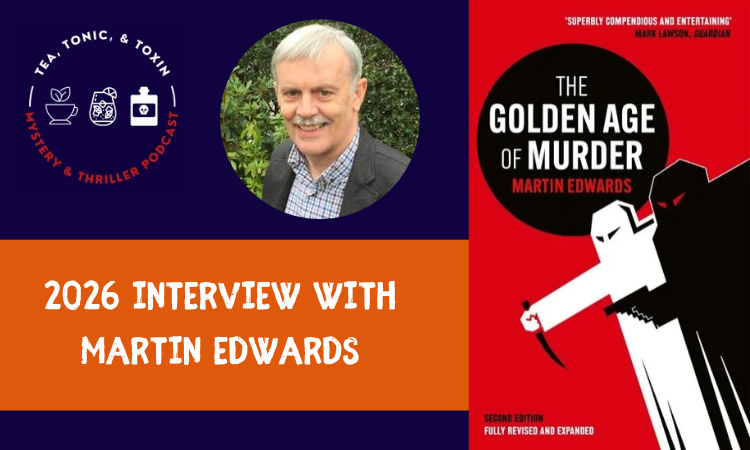
Special Guest Martin Edwards

Martin Edwards is an award-winning crime novelist, historian, and President of the legendary Detection Club, whose past presidents include Agatha Christie and Dorothy L. Sayers. His acclaimed books include The Golden Age of Murder, The Life of Crime, and The Story of Classic Crime in 100 Books. He also received the prestigious Crime Writers’ Association Diamond Dagger for lifetime achievement.

Scroll down to learn more about Martin Edwards, the Detection Club, and the extraordinary writers who transformed detective fiction during its Golden Age.

Martin Edwards - The Golden Age of Murder - Tea Tonic and Toxin Podcast and Book Club

About Martin Edwards

Martin Edwards is a British crime novelist, historian, editor, and one of the world’s leading authorities on classic detective fiction. His work has earned numerous awards for fiction, nonfiction, short stories, and scholarship, including the Crime Writers’ Association Diamond Dagger (for Lifetime Achievement).

Born in Cheshire, England, Martin studied law at Balliol College, Oxford, and enjoyed a successful career as a solicitor while establishing himself as a crime writer. His novels include the Harry Devlin mysteries, the Lake District Mysteries, and the Rachel Savernake series, which draws inspiration from the ingenious plotting and atmospheric storytelling of Golden Age detective fiction.

Martin’s nonfiction has helped reshape our understanding of crime writing’s history. His groundbreaking The Golden Age of Murder explores the lives, friendships, rivalries, and secrets of the writers who revolutionized detective fiction between the world wars. The book won the Edgar, Agatha, Macavity, and H.R.F. Keating awards. His equally ambitious The Life of Crime: Detecting the History of Mysteries and Their Creators examines the evolution of crime fiction across centuries, countries, and storytelling traditions.

Since 2015, Martin has served as President of the Detection Club, the celebrated organization founded in 1930 by leading British mystery writers. He is also the Club’s archivist, archivist of the Crime Writers’ Association, and a consultant to the British Library Crime Classics series, helping introduce new generations of readers to forgotten and overlooked mysteries.

Through his novels, historical research, anthologies, and literary criticism, Martin has devoted much of his career to preserving the rich heritage of crime fiction while ensuring that its most remarkable stories continue to find new audiences.

Martin Edwards - The Golden Age of Murder - Tea Tonic and Toxin Podcast and Book Club

About The Golden Age of Murder

What if the lives of the writers behind the world’s most ingenious murder mysteries were every bit as fascinating as the crimes they invented?

In The Golden Age of Murder, Martin Edwards takes readers behind the scenes of British detective fiction’s extraordinary flowering between the two world wars. At the center of the story is the Detection Club, founded in 1930 by a remarkable group of writers that included Agatha Christie, Dorothy L. Sayers, Anthony Berkeley, and Freeman Wills Crofts.

These authors transformed the detective novel into one of the most popular literary forms of the twentieth century. But behind their carefully constructed puzzles lay complicated personal lives, unconventional relationships, professional rivalries, and experiences that sometimes found their way into their fiction.

Drawing on extensive archival research, correspondence, and previously overlooked historical material, Edwards reveals how these writers influenced one another, experimented with the conventions of detective fiction, and responded to the dramatic social changes of their time.

First published in 2015, The Golden Age of Murder won four major awards for nonfiction crime writing. An expanded tenth-anniversary edition appeared in 2025.

For readers who love Agatha Christie, Dorothy L. Sayers, Margery Allingham, and the remarkable detective novels of the 1920s and 1930s, The Golden Age of Murder offers an absorbing look at the people, personalities, and literary innovations behind the mysteries.

About The Detection Club

Imagine a gathering of Britain’s greatest detective novelists, complete with elaborate initiation rituals, mysterious oaths, and spirited debates about the art of murder—fictional murder, of course.

Founded in 1930, the Detection Club brought together many of the most influential writers of the Golden Age, including Agatha Christie, Dorothy L. Sayers, Anthony Berkeley, and Freeman Wills Crofts. G. K. Chesterton became its first president.

The Club provided a place for crime writers to exchange ideas, celebrate their craft, and collaborate on literary experiments. Its members produced innovative projects such as The Floating Admiral, a detective novel written collaboratively by leading authors of the day.

Today, the Detection Club continues to bring together distinguished crime writers. Martin Edwards became its eighth president in 2015, following in the footsteps of Chesterton, Sayers, Christie, and other celebrated figures.

As both President and archivist, Martin has a particularly intimate understanding of the Club’s history, traditions, and influence on the evolution of detective fiction.

Questions for Martin Edwards

  1. What first sparked your fascination with classic detective fiction, and how did that interest evolve into a career as both a crime novelist and literary historian?
  2. In The Golden Age of Murder, you explore the extraordinary personal lives of writers such as Agatha Christie, Dorothy L. Sayers, and Anthony Berkeley. What surprised you most during your research, and did any discoveries fundamentally change how you read their fiction?
  3. The Detection Club was founded in 1930 by some of the most celebrated mystery writers of the era. What brought these authors together, and how did their friendships, rivalries, and collaborations influence the development of detective fiction?
  4. As the Detection Club’s President and archivist, you’ve had extraordinary access to its history. What are some of the Club’s most fascinating traditions, and what might surprise readers about the organization today?
  5. Golden Age mysteries are sometimes dismissed as artificial puzzles set in an idealized England. How does The Golden Age of Murder challenge that perception, and what do these novels reveal about the anxieties and social changes of the interwar years?
  6. Your work with the British Library Crime Classics series has helped introduce modern readers to long-forgotten detective novels. Which rediscoveries have been especially rewarding, and what makes a neglected mystery worth bringing back into print?
  7. You’re both a historian of classic crime fiction and a successful contemporary mystery novelist. How has your research influenced your own storytelling, particularly the Rachel Savernake novels?
  8. For readers who want to venture beyond Agatha Christie and Dorothy L. Sayers, which three Golden Age mysteries would you most enthusiastically recommend, and why?

Share Your Thoughts About The Golden Age of Murder and Guest Martin Edwards

Tell us what you think, and we may share your thoughts in our next episode and send you a fabulous sticker! (It really is a pretty awesome sticker.)

About Tea, Tonic & Toxin

Tea, Tonic, and Toxin is a book club and podcast for people who love mysteries, thrillers, introspection, and good conversation. Each month, your hosts, Sarah Harrison and Carolyn Daughters, will discuss a game-changing mystery or thriller from the 19th and 20th centuries. Together, we’ll see firsthand how the genre evolved.

Along the way, we’ll entertain ideas, prospects, theories, doubts, and grudges, along with the occasional guest. And we hope to entertain you, dear friend. We want you to experience the joys of reading some of the best mysteries and thrillers ever written.

Tea, Tonic, and Toxin Book Club and Podcast - Mysteries and Thrillers

Teasers & Tidbits

STAY MYSTERIOUS

Get our most mysterious newsletter once a month. All mysterious goodness (PLUS giveaways). It’s delightful. We promise.